Thursday, 24 April 2008

RIDING THE STORM - PLANTING FOR CLIMATE CHANGE

Alice's article about planting for climate change has been published in this months Garden Design Journal. Read more about bimodal plants that can ride the storm.

With changing weather patterns, designers may need to consider a palette of plants that are able to cope with more than one extreme.

The capricious weather we have been enduring over the last few years has highlighted the need for a new approach to our planting choices. In the past we could identify gardens as 'boggy' or 'dry' with some ease, and then plant them accordingly, but things are becoming less and less predictable. Weather extremes of flood and drought can both occur in the same garden within a short period: often without warning. If we can no longer rely on the accepted weather cycles of previous years, we must take action to adapt our planting designs to cope with the unpredictable impact our volatile weather may have on growing conditions.

In recent years we have all become experts in drought tolerant planting, but for the unpredictable weather challenges ahead we will need to develop a sophisticated arsenal of bimodal plants: that is, plants which can cope with more than one type of weather extreme.

Interestingly, plants that typically grow in moist habitats often survive suprisingly well in drier soils (so long as the soil is reasonably fertile) but the opposite is rarely true. Plants that are adapted to dry conditions often do not cope with flooding and waterlogged soils.

In fact, as a general rule, all grey and silver leaved plants hate flooding. This includes drought tolerant plants such as senecio, buddleja, echinops, eryngium, thyme and lavender. Therefore it is best to avoid using all of these mediterranean plants unless they are in planted in pots or raised beds, or have excellent drainage.

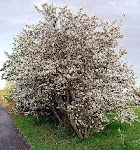
Beech and Cherry trees are known to be particularly vulnerable to flooding, so a sensible stormscaping choice would be to substitute them with storm proof alternatives that offer similar visual characteristics. Why not try using hornbeam as an alternative to beech for trees and hedges, as this tolerates wind, drought and flooding. As an alternative to the cherry tree, why not plant amelanchier: whose clouds of spring blossom are unrivalled in my garden. Amelanchiers also provide exquisite autumn colour – and if planted as a multi-stem specimen can act as a mini windbreak. An alternative source of storm proof autumn colour can be found in the form of the vibrantly coloured Liquidamber styraciflua or Acer saccharinum. – both of which tolerate extreme of flood and drought with some ease.


Few trees, except the large swamp Cyprus (taxodium distichum) can tolerate more than one month of submersion during the growing season but as a general rule, broad-leaved trees tolerate flooding better than conifer trees. Try alder (Alnus) river birch (Betula nigra) hornbeam (carpinus) willow (salix) and ash (fraxinus) for your best chance of success.

Most woody shrubs are not any better adapted to flooded conditions than trees. Common casualties of extreme weather conditions include Forsythia, Daphne, Camellias and Yew: who simply panic in waterlogged soil. These can be grown in a pot, or substituted for plants that can more effectively tolerate volatile weather conditions.

We can probably all think of a few ’hard as nails’ shrubs, such as Fatsia japonica and Viburnum tinus, that can tolerate almost anything you throw at them but wouldn’t it be boring if these were our only options for stormproof shrubs. Cercis Canadensis, one of my all time favourite planting choices, is surprisingly storm tolerant – and can cope with long term drought as well as a good few days of standing water. Hibiscus moschetos is another fantastically elegant shrub that is suspiciously hard to kill!

Cornus mas and Berberis thunbergii are two other shrubs commonly reported to be tolerant of flooding: even during the growing season. An ideal storm and flood tolerant plant partner for your cornus would be asplenium, Liriope, Aquilegia or dryopteris filix mas. Convallaria majalis is another woodland perennial that survives both drought and flooding but it is remarkably invasive and can be hard to control in a planting scheme so it is a less ideal choice on a domestic garden scale. Avoid hellebores and tiarella entirely as they so not cope well with waterlogged soil.

My ‘wonder plant’ award must go to the ornamental grasses – specifically Calamagrostis x acutiflora ‘Karl Foerster’. This wonderful grass is a deserved favourite amongst garden designers, and it is easy to see why. This plant seems to cope with almost anything I throw at it. It will happily grow in saturated soil and standing water . It copes effortlessly with drought and is tolerant of extremely acidic soils. It will return to a stiff upright position after having been bent flat to the ground by 80mph winds and it will stand strong through a soggy winter. My other stormproof favourite is Panicum virgatum: especially ‘Northwind’ and ‘Strictum’ which offer similar ‘superhero’ characteristics, but a softer effect.

Bulbs notoriously hate to be left standing in water, especially Eremurus, and are likely to rot away in waterlogged soil. In gardens where flooding is a prevalent threat, you may be better to plant your bulbs into pots in the autumn and treat them as seasonal bedding to get round this issue: planting them out into the border just a few weeks before they are due to flower. In gardens that only suffer from minor waterlogging, try Camassia - which originates from the moist meadows of North American prairies.

Although flooding is a natural event that can’t be prevented, you can be prepared for it. We all know that organic matter is the key to improving soil performance in drought conditions but did you realise that good soil preparation is also key to defending your garden against the ravages of flooding? Organic matter helps bind clay soils into crumbs, so that water infiltrates more quickly after a downpour. Improving the soil structure also makes water more easily available to plant roots, which can grow through gaps between the soil particles.

You can also help to prepare your garden for storms when you are planting and pruning specimens. Plant small and water deeply to encourage deep roots. These will not only anchor the plant and help it cope with strong winds, but will provide a vital connection to the water table deep underground. Choose multi-stem specimens where possible as these will act as a miniature shelterbelt and help to slow down racing winds.

There are other ways to cheat the weather with plants that are less tolerant of rough and volatile conditions. Drought tolerant plants which are not inherently wind tolerant can be pruned to make them tolerant of wind. Sedum, for example, can be cut back by half in early June – to about 4 inches, or pinched to control its height. I have found this very effective in my windy Midlands garden and my sedum stand strong and structural all through the winter where they used to flop and flail.

We are only just beginning to learn how to garden in a changing climate and I am sure we will continue to be surprised at just how quickly plants adapt to new environmental conditions. For the moment, if we just think a little harder about how we can plan our planting choices to stand up to the unpredictable - and experiment to push the boundaries of our existing knowledge

Tuesday, 1 April 2008

GREEN MANURES - WHAT SHOULD I GROW?


We all know that compost is garden gold - but it can be hard to produce enough of the stuff for the demands of a garden and allotment - and it can be very pricey to buy in bulk

A cheap and sustainable way to improve your garden soil is by growing a green manure.

Several plants can be grown as green manures: Try fenugreek, field lupins, broad beans or clover for a spring or summer planting. These will grow to usefully smother weeds that might otherwise threaten to engulf the bed - as well as adding nutrients to the soil.

For an autumn planting, try rye or Mustard.

Broadcast sow directly into an empty flowerbed. Once it has grown to form a lush, carpeting green crop (and before it flowers!) it should be dug directly into the soil, improving its organic content and the soil structure. Decaying green manures can suppress plant growth so allow at least two weeks between incorporation and planting or sowing.

Nothing could be simpler - all you need for this approach is a bit of time.

Sunday, 2 March 2008

ALICE FEATURED IN GARDENS ILLUSTRATED DESIGNER SHOWCASE


SHOWCASE

Gardens Illustrated, March 2008

Alice Bowe
BASED: Birmingham and Nottingham
STUDIED: Fine Art Degree, Ruskin School (University of Oxford); postgraduate diploma, Oxford College of Garden Design.

''Alice Bowe revels in bold dramatic planting. 'I always double the border width and halve my plant list,' she says. 'Some of the most sexy schemes only use three plants'.


Friday, 22 February 2008

ALTERNATIVE GARDEN LAWNS - MOSS


Many people spend a lot of their spare time fighting to remove moss from their garden lawns - but actually if you think about it, moss is a great alternative to a traditional lawn, especially for shady gardens.

In fact mosses tend to thrive in areas where traditional lawns suffer. They love compacted soil. As nonvascular plants they do not possess true roots and they get their nutrients and moisture from the air by capilliary movement. Mosses also seem to prefer poor quality soil with low nutrient levels - they really are wonderful plants.

Before you head straight off to buy some moss, one word of caution: mosses love acid soil, so this is one of the rare occasions when it is actually worth testing the acidity of your garden. A ph of 5.0 to 6.0 is ideal

Moss forms dense, low growing mats in the garden. I can see why they are so revered in Japanese gardening - and think it's time we caught on to their potential...

The best moss to use as a lawn alternative in shady areas is Fern Moss (Thuidium delicatulum). This moss will tolerate dappled sunlight and morning sun but not direct afternoon sunshine. For an instant effect, these moss plants are available by the square metre to be laid like turf.

Alternatively you can use smaller plants or plugs which will grow and knit together over time.


FOR MORE INFORMATION ON MOSS

Join the Japanese Garden Society

Visit the Garden at The Bonsai Nusery in Cornwall which has a great moss garden (along with other fantastic traditional japanese elements)

Check out George Schenk's brilliant book on Moss Gardening

MOSS SUPPLIERS

Moss Acres USA

Wednesday, 20 February 2008

ENVIRONMENT AGENCY PUSH FOR UNIVERSAL WATER METERING

According to Barbara Young, chief executive of the Environment Agency "Evidence shows that metering, cuts water consumption by at least ten per cent."

The Environment Agency was commenting on the government's Water Strategy for England publication, which highlighted the need for new houses to be fitted with water efficient appliances. These could include things like water butts attached to down pipes in order to collect rainwater.


Barbara Young, chief executive of the EA, said that, although pleased the government recognised the need for compulsory metering where water was scarce, she wanted to see a "far greater level of urgency put on introducing it".

"The government has set a timescale which looks to introduce universal metering in water stressed areas before 2030... this is not remotely early enough," she said.

Other ways of saving water include using a watering can instead of a hosepipe where possible and mulching your garden regularly to reduce evaporation.

Tuesday, 12 February 2008

ALTERNATIVE GARDEN LAWNS - CLOVER

A popular replacement for traditional lawn turf is Clover - and I can see why...


LOW MAINTENANCE

Does not need to be mowed as often as traditional lawns which cuts down on labour and lawnmower emissions making it a cheaper, greener alternative.

NO FERTILISERS
Clover is a fixes nitrogen so it grows well even in poor soil and doesn't require fertilisation which makes it a sustainable option as well as a less expensive option.

COLOUR
Clover has long roots enabling it to access water at deeper levels. This makes it drought tolerant and so it stays green even in the driest summers. Clover also tolerates dog urine without bleaching yellow.

INEXPENSIVE
No need to spend money aerating, irrigating and fertilising your lawn!
Clover tolerates compacted soil better than lawn grass does.

In addition, clover produces beautiful little flowers - and you can feel smug in the knowledge that you are improving biodiversity in the garden.

Although clover lawns do not stand up to heavy traffic as well as traditional lawns, they are fine for most garden areas and work particularly well in more shady areas where traditional lawns would be patchy.

The best clover for lawn use is the Dwarf Dutch White which can reach a height of about 4". Try it today

Monday, 11 February 2008

DROUGHT TOLERANT AUSTRALIAN PLANTS - LILLY PILLY

One of the drought tolerant Australian plants I am currently trying out in my garden as an alternative to traditional topiary is the Lilly Pilly.

The lilly pilly is one of the most popular plants in Australian gardening, particularly for topiary and hedging. Lilly pilly is the common name for a range of separate genera of what are basically evergreen rainforest plants with glossy green leaves.

Once lilly pillies were all known as eugenias. In recent years botanists have divided them into several genera, including Acmena, Syzygium and Waterhousea. They are very adaptable because they can take it dry or wet for long periods at a time but they do like it best where there is some good summer rainfall and deep soil.

They supposedly don’t tolerate frosts, but according to Di Johnson of the Garden Vineyard, they are undamaged by the mild frosts she recieves. I'll let you know how they fare here in the Midlands UK.

The most commonly available form here in the UK is Syzygium australe which has more pendulous red tipped new growth than many.

If anyone has tales they want to share of growing lilly pillys outside of their native lands - or suppliers outside the UK, please contact me through my garden design studio website

UK SUPPLIERS (according to the RHS!)

Syzygium australe

Deelish Garden Centre, Ireland

The Romantic Garden, Norwich

Shrubland Park Nurseries, Ipswich